Prime vs Zoom Lenses for Cotswold Villages: A Practical Comparison
Pack light, they said, so you took the 50mm. Then you stood at the top of Chipping Campden's High Street, watched the light rake down the limestone terraces, and realised the picture you wanted sat about four steps further back than the wall behind you allowed.
That is the prime-versus-zoom question in a single moment, and it has almost nothing to do with sharpness charts. Both kinds of lens make lovely photographs of honey-stone cottages. What matters is how you move through a village, how quickly the light changes, and how much you are willing to carry and swap in the middle of a lane.
The Cotswolds are not one location. They are a hundred small stages: a bowed shop front in Stow-on-the-Wold, a shallow river at Bibury, a footpath climbing out of Painswick, a church porch at Stanton. Each one asks a slightly different question of your bag, and the honest answer is that no single lens is perfect for all of them. But you can tilt the odds in your favour by understanding what you actually photograph when you get there.
What Cotswold Villages Ask of a Lens
Village photography is a set of constraints wearing a pretty hat. The streets are narrow, the buildings are tall, and the wall behind you is often closer than you would like. Meanwhile the best material is small: a pair of weathered oak doors, a boot scraper, a metal latch, the curve of a drystone wall above a field gate. You will often find yourself working in two modes at once, wanting the wide view and the tiny detail within a few paces of each other.
Light is the second constraint. Honey limestone glows in soft, low, angled light, which is why early mornings and late afternoons matter here, and why a bright overcast day is genuinely useful rather than a disappointment. Church interiors, north-facing lanes and shaded courtyards are dim, and the popular villages fill up between mid-morning and late afternoon in summer. In Bourton-on-the-Water, for example, the low bridges and riverbanks can be almost empty at 7am and pleasantly busy by 11am. By noon, a wide shot of the river might include three coach parties and a queue for ice cream.
Then there is the physical side. You are walking. The ground is uneven. It may be drizzling. Quite often you cannot step backwards to fix a composition. Add a low sun, a narrow pavement, and a passing delivery van, and the difference between a zoom ring and a lens change becomes very practical indeed.
The Case for Primes
A 35mm or 40mm prime on a full-frame camera is, for many people, the ideal single lens for a village day. Use it horizontally and you get a street. Turn it vertical for a doorway. Step in close for a detail. It is unglamorous and it works. A 35mm f/1.8 or f/2 is small enough to hang on a strap all day and fast enough to keep shooting when the light drops.
Add a wide option in the 20-24mm range for church interiors and the tightest corners, and a short telephoto around 85mm for isolating details and stacking distant rooftops. Plenty of photographers carry a 24mm and a 50mm and leave everything else at home. That two-lens kit covers more of the Cotswolds than you might expect, especially if you are happy to walk a few steps to change your framing.
The advantages are real. Apertures of f/2 or wider let you keep shooting a lantern-lit doorway or a dim porch after the day visitors have gone, and they let you use depth of field, which is how a close-up of a latch becomes a photograph rather than a record. A small lens also attracts less attention, and a modest-looking camera tends to get a friendlier response from residents.
The cost is inconvenience. You will miss a shot while changing lenses, and you will change them less often than you think when it is raining. There is also the risk of carrying the wrong lens at the wrong moment: a 50mm when the street demands a 24mm, or a 24mm when a single cottage door would be better served by an 85mm. Primes reward patience and punish indecision.
The Case for Zooms
A 24-70mm f/2.8, or a 24-105mm f/4 if you prefer a lighter bag, handles the great majority of a village day without a single lens change. That matters more than it sounds. Framing precision is easy when you can stand still: from a narrow pavement, at the edge of a stream, or on a footpath with a hedge at your back, zooming is the only way to compose without physically moving.
Zooms also keep dust and moisture out of the camera. Changing lenses beside a drystone wall on a breezy day is how sensor spots happen, and one of them in the sky above a clear blue shot of Broadway Tower is a small tragedy you will spend an hour fixing at home. If you are visiting in autumn or winter, when the lanes are muddy and the air is damp, the sealed convenience of a zoom becomes even more appealing.
If you are travelling with people who are not photographers, a zoom is simply kinder. You take the frame and walk on. Nobody waits while you deliberate between two lenses in a car park. That social dimension is easy to forget when comparing specifications, but it shapes the photographs you actually come home with.
The drawbacks are weight, slower apertures and laziness. A zoom used carelessly flattens your perspective choices, because zooming is easier than moving and the two do not look the same. A useful habit is to treat a 24-70mm as three primes: shoot for a while at 24mm, then 35mm, then 50mm, and only zoom when the composition demands it. Your feet should still do some of the work.
Scene by Scene
Long terraced streets
Chipping Campden's High Street and Broadway's wide main road both reward a short telephoto, somewhere between 70mm and 105mm, which compresses the terraces into a satisfying stack of gables and chimneys. A 35mm gives you more of the curve of the street, but it also gives you the parked cars. A zoom lets you crop those out with the turn of a ring, or with a couple of steps that you can actually take.
If you are using a prime, a 50mm can work from the opposite pavement, but you may need to shoot vertically and stitch later, or accept a tighter view. In Broadway, the wide verges give you more room to move; in Chipping Campden, the pavements are tighter and the telephoto compression is often the cleaner solution.
Church interiors and dim porches
Cotswold churches provide one of the strongest arguments for a fast wide lens. A 20mm or 24mm prime at f/1.8 lets you hand-hold in the gloom of a side chapel, photograph carved tombs and medieval glass, and still include enough of the arcade to give a sense of place. A 24-70mm f/2.8 is workable if your camera has good high-ISO performance and stabilisation, but it will not match a fast prime in the darkest corners.
Remember that many churches ask for a donation, restrict tripods, and prefer quiet discretion. A small prime helps here. So does turning off the autofocus beep and avoiding flash, which rarely flatters stone and stained glass anyway.
Cottages and details
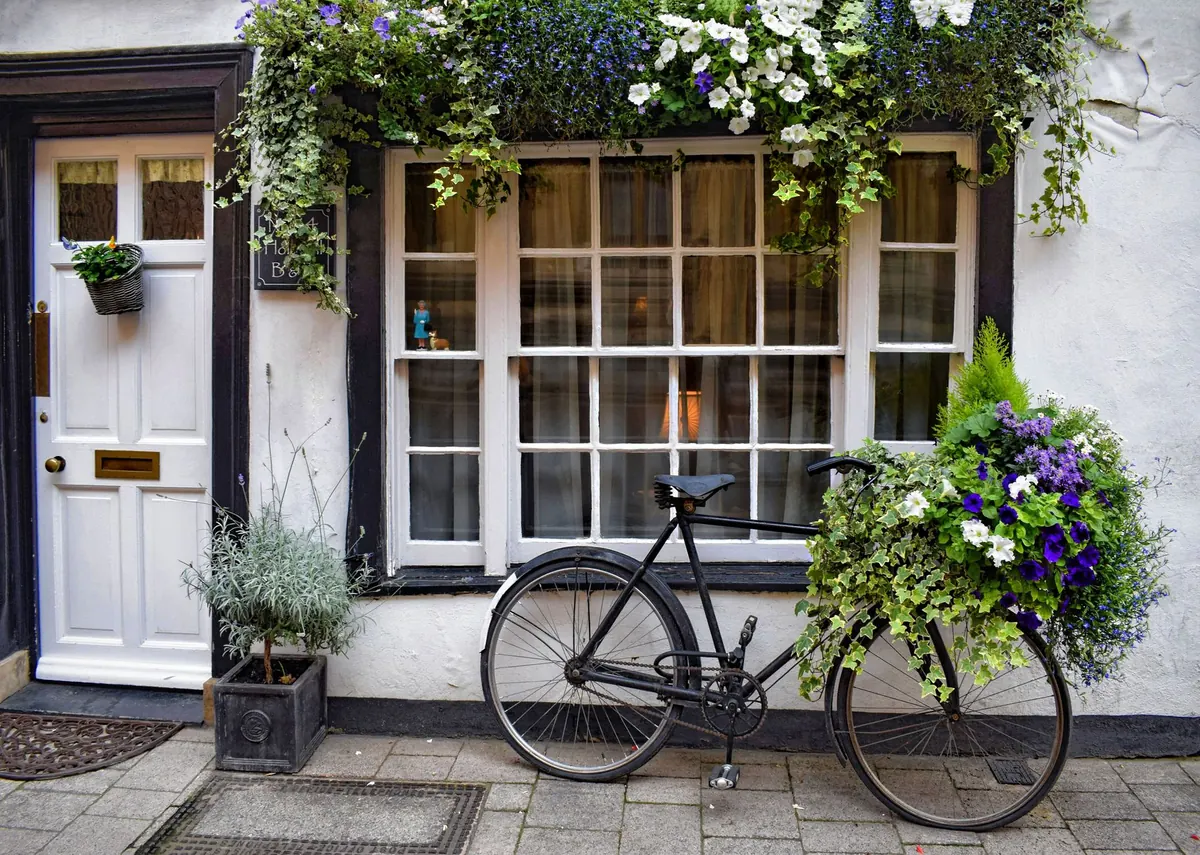
This is prime territory. A 50mm or 85mm at f/2.8 to f/4 isolates a latch, a doorknob, a window box, or the texture of a drystone wall without turning the background into mush. The Cotswolds are full of small vignettes: a green door in Bibury, a worn step in Lower Slaughter, a rusted boot scraper beside a threshold. A macro lens is not essential, but a short telephoto with a close focusing distance is a joy.
A zoom can do this too, especially a 24-105mm at the long end, but you need to be deliberate about your background. The temptation is to stand back and zoom in, which flattens the subject against the wall. Move closer instead, and let the lens do less of the work.
Footpaths and wide views
When you climb above the villages, the landscape opens up. A 24mm or 28mm lens lets you include a drystone wall in the foreground, the village below, and the